Sugardaddy · $DADDY · a Flywheel coin on Robinhood Chain
Daddy's home.
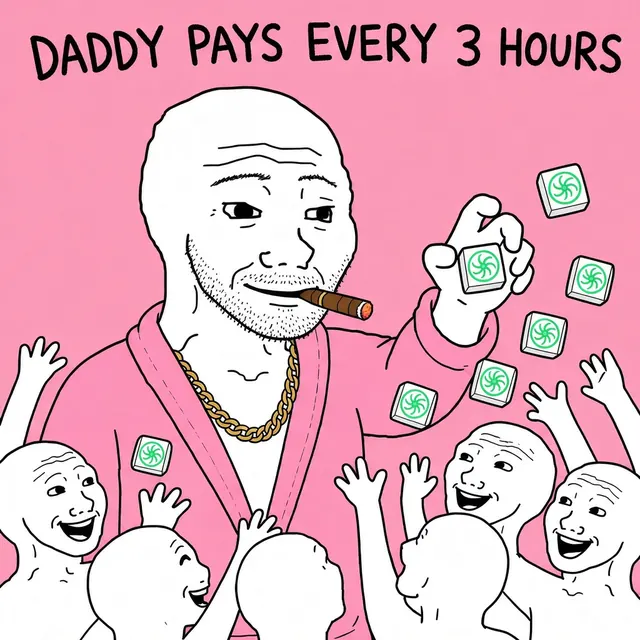
Every 3 hours Daddy claims his Flywheel creator fees, drops a sugar cube in his tea and goes shopping at the top of the leaderboard. You get the bags. Daddy gets the satisfaction.
- cycles run
- …
- next shopping list
- …
Generous, never needy. Not financial advice.

Back in a moment, darling
Daddy is still getting dressed
Cufflinks, robe, a dab of cologne.
Latest cycle
What Daddy did on his most recent shopping trip. Straight from the contract's events.
Loading Daddy's latest receipt…
The furnace
Everything Daddy has ever burned, all cycles added up: the $DADDY he buys and burns, half of every basket coin, and any unclaimed airdrop leftovers burned when an epoch closes.
Daddy's calling card
Check them yourself. Daddy likes the suspicious type.
The allowance, itemised
DADDY'S PARLOUR
receipt · every cycle · at least 3h apart
- Buy & burn $DADDY20%
- Top 3 Flywheel coins, equal parts80%
- …of which burned½
- …of which pushed to your wallet½
- Every 4th cycle: ranks 4–6 instead✓
- Minimum to qualify10M $DADDY
- Claiming, forms, begging0
10M = 0.01% of the 100B supply. Below that, gas would eat the allowance.
THANK YOU, COME AGAIN 🍬
- Cycles run at least 3 hours apart. Anyone can call
cycle(); the keeper usually does. Each buy is capped at about 5% price impact; anything over the cap waits for the next cycle and keeps its 20%/80% split. - Rankings follow flywheel.cash: graduated coins from the Flywheel factory, by FDV, with a minimum-liquidity floor. The contract checks the list on-chain, and anyone can
register()a missing coin, which blocks the cycle until the list is honest. - Within 24h the keeper wallet commits a Merkle snapshot of holders. The full list is published at
https://spoiltbydaddy.com/snapshots/; its sha256 is recorded on-chain in the commit and the Merkle root is stored on-chain, so anyone can verify it. - Anyone can push the airdrop in batches with
distribute(). Whatever isn't delivered after 7 days gets burned. If a transfer to a holder fails, it isn't burned: it stays owed to that holder and anyone can retry it, even later. No snapshot in 24h? The whole airdrop half burns.
Daddy's favourites
Daddy's chequebook
Every cycle, newest first: what came in, what was bought, what burned and what went to holders. Tap a cheque for the full breakdown; gift slips are holder rewards claimed back in.
Airdrop snapshot log
Every epoch's holder list, its on-chain root, and every distribute batch. Verify downloads the snapshot, rebuilds every leaf and the Merkle root in your browser, checks the exclusion rules and compares with epochInfo(epoch).root on-chain. For a fully independent rebuild from $DADDY Transfer logs: python3 scripts/verify_snapshot.py verify --contract C --epoch N --fetch-uri.

Latest airdrop
| epoch | snapshot time | status | holders | root | snapshot | commit | batches | close | check |
|---|
The naughty list
Pools and routers that hold $DADDY don't get an allowance. The list is append-only on-chain: the keeper can add a confirmed pool or router, never remove one. Uniswap v4 pools are excluded automatically.
| address | since | reason | tx |
|---|
Small print, because Daddy is responsible
Here's exactly who you're trusting. Read it before you hold $DADDY.
Who you trust
- The dev's keeper wallet. Trust required for one step. It picks the holder list (snapshot) for each airdrop and adds pools to the exclusion list. It can't take the fees or the tokens. At worst it can misdirect or withhold one epoch's airdrop half, and every snapshot can be re-checked (Verify button above, or
scripts/verify_snapshot.py). If the keeper stops, cycles still run and each missed airdrop half is burned after 24 hours;distribute()is open to anyone. - Flywheel. The fee system belongs to Flywheel. The factory owner is a single key, and the "operator" is a plain wallet. There are no proxies and no upgrades on the factory or hook. The operator decides when, by which route and at what minimum price non-WETH fees get converted to WETH, so that part of Daddy's income can arrive late, at a worse price, or not at all (mistake or hacked key). Neither can take funds already credited to SugarDaddy or block its claims. WETH-side fees are credited directly.
- Buy-side fees wait for Flywheel's operator. When someone buys $DADDY, Flywheel takes its fee in $DADDY, and it only becomes ETH for SugarDaddy once Flywheel's operator converts it. Fees from sells arrive as ETH straight away. So when the market is mostly buying, part of Daddy's allowance depends on that operator turning up.
- Uniswap v4 and Robinhood Chain, which everything runs on.
Watched for you: from launch, the keeper alerts on Flywheel factory ownership or operator changes, so a swap of keys doesn't happen quietly.
Exclusions
- Burn addresses, the contracts involved, and liquidity pools, vaults and routers don't get airdrops. A pool is only added once it's confirmed against its exchange's factory, or because it's on a published list of known vaults/routers. Every exclusion is on-chain and on the naughty list above with its reason. Exclusions are permanent: they can never be removed.
- Known risk we accept: a brand-new pool created just before a cycle can receive one round of airdrop tokens before it's excluded from the next round on.
Other risks
- Prices move. Buys have slippage limits (a buy fails if it would come back more than 10% under the spot price after fees), but MEV and thin liquidity can still cost value.
- The coins Daddy buys are small memecoins. They can go to zero. So can Daddy.
- The snapshot is taken at the moment of the cycle. People can buy just before and sell just after; trading fees make that costly, but it's possible.
- Airdrops go out in batches after each cycle, not instantly.
Rewards on held coins
While Daddy holds the basket coins he earns Flywheel holder rewards like any wallet. Anyone can call claimHolderRewards() to pull them back into SugarDaddy, and the next cycle spends them. Daddy doesn't leave money on the nightstand.
Not financial advice. Nothing here is an offer, a promise of returns, or a recommendation. Do your own research, and only spend what you'd happily set on fire.